Saturday, September 15, 2007

Remembering That It's Nice
To Be Alive

Two photos from SFGate.com.

"A star in stripes: One of two four-month-old Amur tiger cubs makes its debut at the Brookfield Zoo next to its mother Tiara, 12, in Brookfield, Illinois. The number of Amur tigers in the wild is estimated at 350 to 450."

Of course I would choose this one. That old mama and baby theme. And, it is cats after all.


"I feel like such an ass: A donkey looks at firefighters with pleading eyes after getting trapped in a well near Underwood, Minnesota. Rescuers dismantled the well to free the beast, which lost a bit of fur and some of its precious dignity."

Isn't it wonderful that people will rescue animals? This is taking a bit of trouble, and I don't imagine that there are many farms in Minnesota that are dependent on donkey power.

Return on Success

From Bush's Thursday night speech:
The principle guiding my decisions on troop levels in Iraq is "return on success." The more successful we are, the more American troops can return home.” And in all we do, I will ensure that our commanders on the ground have the troops and flexibility they need to defeat the enemy.
What this says to me is that until they succeed, they don't get to come home. And if success is impossible? If it is not possible to defeat this enemy? Where is he going to get the troops? More stop-loss actions? Longer rotations with shorter breaks? A draft?

What if this mess simply can't be solved by anything this man knows how to do?

I remember reading that generals don't like to have a president who hasn't seen combat, because he is too willing to throw the troops into unnecessary wars. And of the officials who had anything to do with this war, only Colin Powell had combat experience, and Colin Powell didn't think this war was such a good idea.
THE former American secretary of state Colin Powell has revealed that he spent 2½ hours vainly trying to persuade President George W Bush not to invade Iraq and believes today’s conflict cannot be resolved by US forces.

“I tried to avoid this war,” Powell said at the Aspen Ideas Festival in Colorado. “I took him through the consequences of going into an Arab country and becoming the occupiers.”

Powell has become increasingly outspoken about the level of violence in Iraq, which he believes is in a state of civil war. “The civil war will ultimately be resolved by a test of arms,” he said. “It’s not going to be pretty to watch, but I don’t know any way to avoid it. It is happening now.”

He added: “It is not a civil war that can be put down or solved by the armed forces of the United States.” All the military could do, Powell suggested, was put “a heavier lid on this pot of boiling sectarian stew”.
***
According to Powell, the US cannot “blow a whistle one morning” and have all American forces just leave.
***
Powell believes that a reduction in US forces will have to be accompanied by talks with Syria and Iran. “You have to talk to the people you dislike most in this dangerous world.”

The general and former joint chiefs of staff added: “Shi’ites will ultimately prevail because they are 60% of the population and their militias can be pretty violent. They will prevail also because they are determined not to be ruled again by the Sunnis.

“The Sunnis are struggling for power and survival and it’s going to be resolved by a test of arms. It’s going to be very ugly.”
I don't know what we are going to do now. Powell is right, we can't just pull the troops out. Our invasion made this mess. We have to work on cleaning it up. But, I also don't think that continuing to do what we have been doing is going to make it better. Some say that Iraq is going to fall apart when we leave, no matter what we do, and no matter when that is. And if that's so, perhaps we should leave now rather than see how many more dead Iraqis and coalition forces we can rack up. Before we have sold our grandchildren into indentured servatude to pay for this major bollix.

I think I agree with Powell that we need to bring Syria and Iran into it. Perhaps all of the Arab and Persian countries. And the UN. Things might be less explosive with UN Peace Keepers on the ground instead of an occupying force.

Thursday, September 13, 2007

Remembering How It Was

AMC is running a series, Mad Men, about a New York advertising agency in 1960. I've caught the last three episodes, and I'm hooked. They have the look and feel of the time down so perfectly. Even though I was a high school senior and then a college freshman and in California in 1960, and the series is about working adults in The Big Apple, it almost smells like 1960.

They smoked, and thought nothing of second hand smoke. They drank almost all day long. They were sexist and racist and other things we have outgrown.

In the first episode that I saw, the secretaries test lipstick that the agency is representing. As they try on the shades, they blot their lips on tissues, which are then dropped into a waste basket. After the session, one of the secretaries brings the waste basket to an ad exec, saying, "Here's your basket of kisses." Of course, he wants to know where she got the phrase and she tells him she just thought of it. Later he is telling a few other ad men about this and describes listening to her make intelligent comments as weird. "Like watching a dog play the piano."

And, of course, when she is encouraged to write ad copy, it is on her own time and she doesn't get paid extra.

All of which got me to thinking about how things were for women in those days. About having a B.A. and being asked in job interviews for my typing speed. I also remember one job interview when I was asked what kind of contraceptive I was using. And an interview while I was still married where they wanted to know if my husband would object to my working occasional Saturdays!

When I returned to college after Julie was born, I was 23. And had two small children. UC Berkeley wanted me to get permission from my parents to live off campus! I was having none of that, and responded that I would be happy to live in campus housing with my children. It's amazing what having the guts to stand up for yourself will accomplish. Faced with the prospect of a three week old baby in the dorms, suddenly I didn't need permission after all. My Aunt Florence was newly widowed and returned to University of the Pacific at the same time. She had to get the dean's permission to live off campus although she was 41 and she only got it, as a single woman, because she owned a house within a mile of the campus. One day she was in the grocery store, wearing grey wool slacks and a white cotton blouse, and the dean of women came up to her and explained that if she was seen in town again in slacks she would be expelled.

I remember being told in 1975 by the financial director of the agency I was working at that "no woman can manage a business." Barely two weeks after that, there was a situation where someone had to go to the medical director and tell him something he wasn't going to want to hear. It should have been the accountant, who wouldn't do it. So then he called the financial director, who back peddled like crazy and refused to do it. So, I did it. By the time I got to the man's office, the fact that two men had been afraid to do it had me a little bit tense, but I took my foot in my hand and did it. The response? "Why the hell didn't Larry or Bob come to me about this? Are you the only one in the agency with guts?" Bob didn't really say too much about women being able to manage after that. Well, he did once, but I looked at him and looked at the medical director and looked back and he had the grace to blush.

My grandfather gave my mother some money in the mid-60s, and she decided to buy stock with it. She had to get Daddy's permission. Daddy was outraged. "This," he declared, "is her money. Her father gave it to her. It has nothing to do with me. Why should she need my permission to spend it on anything she wants?" But, that was the law. It was also the law that a married woman needed her husband's permission to have a bank account or credit card in her own name. And, if she didn't, if he died, she had no credit history.

And although things are no longer that bad, they still aren't perfect. It is interesting that watching Mad Men throws certain behaviors in the here and now into sharp relief.

Wednesday, September 12, 2007

AWWW! A Baby!

There is something about a baby anything that charms us. Here, courtesy of SFGate is one month old Malti, at the Calgary Zoo.

Isn't he a sweet looking little boy? I'll bet I'm not the only one who feels like kissing his little forehead. I'm guessing it must be a touch chilly in Calgary, with him having a blanket belted on him and all.

Tuesday, September 11, 2007

The Only Comfort That I know

I have been thinking about what to write, just as I did last year. And it seems to me, that other than changing one word (the number of years it has been), what I wrote last year is as true now as it was then.

I've been wondering all day what I would say. What is there that can be said? There are no words that will take us back to the way things were before The World Trade Center fell. There are no words that will undo the horror of that day or the shame of the years that have followed. Thousands of people, all but the tiniest number of them, totally innocent, are dead. Thousands more are wounded, physically or spiritually. Life will never be the same again. Two countries have been invaded, with no long lasting good and much harm coming out of it so far. The ground in Afghanistan and Iraq is littered with depleted uranium, that our government rained down upon the heads of the civilian populations. There are so many widows and orphans and parents who have lost children where before there were families. The Afghani poppy crop is bigger than ever before and the Taliban is regaining the ground that we left prematurely in order to attack a country that had nothing to do with 9/11. Osama bin Laden is still at large. The Constitution of the United States is under attack from within. Our government has imprisoned people without charges for over five six years. And tortured people. And allowed the rape of Muslim women, who were then driven by the conditions of their culture to commit suicide. Our government has felt no shame in sending mostly working class young people to attack brown skinned people who do not worship as we do. That frail, miraculous thing, the human body has been violated and torn apart and destroyed in nightmarish ways. The souls of those who knew and loved those who were lost in the planes, in the towers, on foreign soil are bruised beyond healing. Every wonderful thing that all of those who were lost would have done, all of the books they would have written and diseases they would have cured and jokes they would have told and babies they would have loved and songs they would have sung and gardens they would have tended -- all lost. Lost forever. And the undreamed of babies of the unborn babies and all that they would have added to the wealth of our souls, all lost. No way to reclaim them. No way to know what we have lost. Only that it was precious.

And the only comfort that I know, is to treasure the people that we love, to hold on to the ones who are left.

Monday, September 10, 2007

The Frog Prince*


This is the fairy tale that should have been read to us when we were little:

Once upon a time in a land far away, a beautiful, independent, self-assured princess happened upon a frog as she sat contemplating ecological issues on the shores of an unpolluted pond in a verdant meadow near her castle.

The frog hopped into the princess' lap and said: "Elegant Lady, I was once a handsome prince, until an evil witch cast a spell upon me. One kiss from you, however, and I will turn back into the dapper, young prince that I am and then, my sweet, we can marry and set up housekeeping in your castle with my mother, where you can prepare my meals, clean my clothes, bear my children, and forever feel grateful and happy doing so."

That night, As the princess dined sumptuously on lightly sautéed frog legs seasoned in a white wine and onion cream sauce, she chuckled and thought to herself:

I DON'T THINK SO!

* Courtesy of my friend Alli. Alli is a Jehovah's Witness and I am an atheist and she once made up a joke for me:
What do you get when you cross a Jehovah's Witness with an atheist?
Someone who knocks on your door and then doesn't have anything to say.

Sunday, September 09, 2007

Rubber Duckie

Photo: Everything's duckie

Michael Penn
Juneau Empire

Eric Forst, president of the Glacier Valley Rotary Club, plucks a plastic duck out of the pond Sunday at Rotary Park during the club's fundraiser. The club offered 5,500 ducks for "adoption" at $5 a piece. Romulo Moskito of Juneau won the $10,000 first prize. Amy Mead is paddling the boat.

Pippin jumped on keyboard. Hitting one key. Two or three appear on monitor. Delete extras. Shoiret poset ethetirkfoiret.

Here is my current ABC

a ,b cv dg et kf dg h ir j kf l m n o p q ir s et u cv w x y z.

IRet irs dgetetetirndg ,betetetetir.


Update: All it needed was to rest overnight. It is working fine now.

Saturday, September 08, 2007

Why We Love Bears


By worldromer, who says,
BEST VIEWED ON SMALLEST SCREEN: We did a bush plane bear viewing fly-in from Kenai to Big River Lake. Unlike land based viewing from 150ft (a half football field away three of us were in an open motorized ROW BOAT so that all filming was from about 20-40 feet away.Despite being that close we WERE NOT ON LAND and the bears had all their uninterrupted space. It was Black bears choice to swim toward our boat. Quite amazing when he gets to within FIVE FEET OF US. Younger Black bears are 'playing' at a tree. Mother Grizzly strolls from a nearby hill and leads her cubs to the water and to US! And NO, Grizzly cub does not try to snack on the ducks.
NOTE: Sorry about a bit of camera 'wobble' the direct result of BEING ON A SMALL BOAT!

Friday, September 07, 2007

AWWWWWW
From Harold II

When Harold sent me the pictures of kittens, he also sent these sweet guys.

So, here, in the spirit of Friday pet blogging, are the pups.


Thursday, September 06, 2007

I'm So Jealous


Jill at Brilliant At Breakfast posted this and I had to copy it for you.

Why, oh why didn't I have this attitude all those years when I was hating my body and feeling guilty every time I ate something not on the list and trying to be someone else* and generally miserable with food? How joyous this woman is! How at ease with herself! How comfortable at the table!

I gives me great comfort to know that there are some young women who are finding acceptance of their own bodies, who are recognizing that it is genes and not sin that dictates their waist size, who can eat and not feel either fear or guilt. I have decided that this is my anthem.

*Well, not really trying to be someone else, I have always really liked who I am, but trying to be in someone else's body.

Tuesday, September 04, 2007

Manna/Chowhound

For seven months, from September of 1944 to April, 1945, the Nazis placed an embargo on all food items to the western Netherlands. By the end, people were eating less than 600 calories a day. Over 30,000 people died of malnutrition. Furniture, the interiors of houses, shops, and orchards were chopped and burned to keep people from freezing to death. Crops were destroyed in bombing raids. On April 29, 1945, in Operation Manna - Chowhound (Manna was the British code name and Chowhound the American), the Allied forces began dropping food behind German lines.

I first became interested in the Dutch Hunger Winter because of
The Dutch Famine Birth Cohort Study, carried out by the departments of Clinical Epidemiology and Biostatistics , Gynecology and Obstetrics and Internal Medicine of the Academic Medical Centre in Amsterdam, the Netherlands in collaboration with the MRC Environmental Epidemiology Unit of the University of Southampton in Britain, has found that pregnant women exposed to famine produced offspring who were more susceptible to diabetes, obesity, cardiovascular disease, microalbuminuria and other health problems.
This study also linked maternal starvation to schizophrenia spectrum personality disorders, thought by some to be caused by the fact that people were eating tulip bulbs since they could not obtain food.

When I was researching this four years ago, I found a memoir on line which I have not been able to find since. It was written by a Dutch woman who had been 13 that winter. She told about the struggle to stay alive, the constant hunger, and hiding a man from the Nazis in the family basement even though that meant that she and her mother had less food. She told of the wonder of the food drops. Of how Spam, which no one had heard of before, became a favorite meal that comforted the survivors for the rest of their lives. Of not knowing what to do with powdered eggs, particularly since they had no fuel to cook them.

And she told of meeting an American who had been involved in the food drops years later and his telling her of flying back to England and seeing that the Dutch had taken pots of white flowers and spelled out "Thanks, Yanks." This is one of those stories that brings tears to my eyes. Such a simple phrase. Such a depth of meaning and wonder. A feeling of sympathy for the Dutch and pride in my countrymen.

And then I think about how far we have strayed from those days. From "Thanks, Yanks" to pre-emptive war.

Monday, September 03, 2007

Labor Day, 2007

I was talking to my mother on Sunday and she mentioned how Daddy and four of my five uncles had gone from impoverished childhoods to very prosperous adulthood, none having much formal education, but all having intelligence, drive, and a willingness to work hard and keep learning. And then she said, "I don't think that's nearly as possible in this economy as it was then. These days people don't start with nothing and build a middle class life. They start in the middle class, get a good education, and then struggle not to sink."

And she's right. Things have changed drastically for working people. These days it's like being trapped in the La Brea Tar Pits. There is a struggle to stay afloat that overcomes too many. The economy favors investors rather than workers. The CEOs are incredibly rich and jobs get exported to countries with cheaper labor, no benefits, and few regulations to get in the way of making maximum profits.

When my Dad was coming up, it would have been considered a disgrace for the owner of a business to be one of the ten richest people in the world and the workers in his (and in those days, it would have been his) firm to be earning minimum wage. For workers to have to apply for medicaid and food stamps to make ends meet. For both parents to have to work to support a family. When I was younger, it would have been unlikely.

But now, the greed at the top, the feeling of "I've got mine, who cares about you," the corruption of politics that allows it to happen are so stacked that the working people are sinking. And are being told that it's an illusion, because the economy is doing so well.

So, for Labor Day, I want you to think about how much harder it has become for people who labor. How much more wealth has been built on their effort and how little of it is being shared with them. And I would like to suggest that instead of going to a Labor Day sale and enriching the already rich, you consider whether or not you need those things. And if you do, how about a yard sale?

When they don't support me, I don't see any need to support them. That goes for Coca Cola who I haven't forgotten made huge contributions to Phyllis Schlafly to defeat the ERA and it goes for Walmart, who drives manufacturing to China in order to keep their costs down

Sunday, September 02, 2007

AWWWWW
from Harold

One Saturday morning, about 12 years ago, I was waiting for my favorite restaurant to open. There were two men, obviously very good friends, also waiting. The three of us waited for BaCar's to open every Saturday morning, all three being compulsively early. This particular week, we started talking.


One thing led to another. We started talking every week as we waited. Since we always sat near ecah other, the conversations would continue once we were seated.


One week they said that it would be easier to continue to talk if I joined them. That's how I met Harold and his friend Pete. Later we added Pete's new girl friend and then her boss (who was already eating there when we were) and finally his girl friend became his wife and we added her mother.


Over the years, Pete's wife's need to sleep in on Saturdays caused them to drop off. Her mother recently left to do other things. But Harold and Christina and I still have breakfast every Saturday morning.


Harold and Christina are two of the best friends a person could ever have. I look forward to seeing them on Saturdays; even though I no longer work on Saturdays, and could sleep in if I wanted.*


Harold and Christina and I are cat people. I have my beloved Hooligans, Christina has four cats, and Harold and his father have rescued a herd of feral cats. Harold rounds them up, takes them in and has them neutered, and releases them. Except, he and his dad have kept a number of the kittens.


We tell each other stories of our cats on Saturday mornings.


And Harold e-mails Christina and me pictures of and jokes about cats. Well, other things as well. But definitely cats and kittens.


He sent me these this week, and I am posting them for you.


* Originally, eating breakfast out on Saturdays was my reward to myself for being the only person in my agency who worked on Saturdays.

Saturday, September 01, 2007

Breakfast for Mama & Baby


A number of you said how much you love giraffes the other day, so I decided to give us another look at a baby and her mother.

The Scarlet O

Dr. Sanjay Gupta, he of the pathetic critique of "Sicko" that resulted in:

Moore said his staffers backed up the film's facts to Gupta before the report aired and that Gupta aired it knowing his facts were wrong.

has done it again.

This time he is all a'twitter because doctors are, in his words, "hesitant to put the scarlet O on a patient's chart."

What a curious usage. Does he consider obesity the equivalent of adultery? Does he think that if we aren't branded we won't know we're fat?* Is he afraid we are getting away with something?** Or that without that O on our med charts doctors are apt to think we are thin and not harangue us about our weight the next time we come in with chicken pox?

And I have to wonder. Has this man actually read "The Scarlet Letter"? Is he at all aware that it is about a woman who, despite the fact that she is less than perfect, is still a good woman and the hypocrisy of the society that has branded her? Does he know that his suggestion says more about the state of his soul than the state of our bodies?

* "Fat? Who me? Are you sure? And here I thought buying clothes in the women's section meant I was old enough to drink!"

** "I had no idea I was dating a fat woman! She wasn't wearing her O!"


Betty's comment: Does this O make me look fat?

Friday, August 31, 2007

Teamwork

This week, a group of evangelical Christians and prominent scientists are visiting Alaska to see the effects of global warming on glaciers, people, and forests.

This is the Begich Boggs Visitors Center, built near Girdwood, about 50 miles south of Anchorage, in 1986. Although the Portage Glacier was retreating, the belief at that time was that it would be possible to see it from the Center until 2020. Instead, all that can be seen now are the ice floes that have calved off. It is one of the sites visited by the expedition.

Also visited was the village of Shishmaref, an Inupiat Eskimo village slowly eroding into the Chukchi Sea because shore ice no longer protects it from fierce winter storms. They will tour the Kenai Peninsula, where more than 3 million acres of spruce forests have been devastated by destructive beetles normally kept under control by colder winters.

To me, this is an incredible tour. Scientists and evangelicals, who do not agree on the origins of life, have set aside their differences to work on preserving it. The idea of stewardship does not depend on finding agreement in all particulars about things. Only that the two groups agree that a terrible thing is happening, that it is being at least added to by human behavior, and that steps must be taken now to stop it.

We need more partnerships like this one. Where well intentioned people turn away from their differences and concentrate on their commonality for the good of all. In a time of great divisiveness, where wedge issues are used regularly to drive people apart and keep them from noticing that they have common interests, this expedition is a lamp in the darkness. A reminder that by far the vast majority of people are well intentioned and can work together.

Thursday, August 30, 2007

Julie Does It Her Way*

Years and years and years ago, long before Maya was born, Granny was a young mother called Mom and Uncle Richard was a little boy called Richard and Maya's Mama was a very little girl called Julie. And they all lived together in Berkeley while Mom went to the university.

Now, Maya knows that every person starts out as a brand new baby, and brand new babies can't talk and they can't walk. Maya has seen, on Maya TV, herself when she was just a little baby and couldn't walk or talk. And every day Maya learns new words and learns to say old words better. Why, Maya used to say Mike Mugalin, and now she says Mike Mulligan. And she used to say valina, and now she says vanilla. So, she knows that learning to talk takes some time and you get better at it as you get older. Most babies start with a single word, and then they learn to say two at a time. It is the same with walking — babies start by standing up and holding on to something and then standing and not holding. Then they walk and hold on and then they walk without holding. That is the way it is usually done.

Indeed, that is the way Richard learned to talk and walk. When he was nine months old, he pointed to the light and said "light!" and that was his very first word. The next day he could say another word and then another. And then he learned to say "What's that?", a very useful phrase indeed, because then Mom would tell him what it was and he would say that word. When Richard was eleven months old, he went to see the doctor. The doctor asked Mom, "Is he trying to talk yet?" and Mom said, "He knows 25 words." Then the doctor, who was very young and hadn't met any children as clever as the children in our family, said, "Well, no. He's saying mamammama and you are thinking he is saying Mama. He's too young to be saying real words." And Mom said, "Richard, say hello to the doctor." And Richard said, "Hello, doctor." And then the doctor said, "Next time I will listen to the mother. Then I won't sound like such an idiot."

Richard started standing up against things when he was about eight and one half months old, and soon wherever Mom went in the house, there he would follow. He might have to lurch from wall to wall and go the long way around, but he could follow her from room to room and by the time he was nine months old and saying "light" he could walk without holding on to something.

When Richard was two years old, Julie was born. Mom and Richard were both as excited as excited about that, and she was a delightful baby and they loved her very much and she loved them very much and life was just wonderful with the three of them to love each other. And every day, Richard learned new things and Julie learned new things and even Mom, who was going to the university like Maya's Dado is now, learned new things. And one of the new things that Mom was learning was child development. She was learning all about how children grow and learn. Her professor said, "Girls learn to talk and walk at a younger age than boys. Second children learn to talk and walk at a younger age than first children. It isn't that the second child is smarter, it is just that the second child wants to keep up with the first child."

"Well," thought Mom, "Richard was a boy and a first child and he learned to walk and talk at nine months. Julie is a girl and a second child — my professor says she will learn earlier than Richard did! She will really be young!"

Well, Julie got to be nine months old, and she hadn't taken a step and she hadn't said a word! "Good heavens," thought Mom, "my professor was wrong. I wonder when she will talk and walk?" Well, the days went by and the weeks went by and the months went by. Not a step. Not a word. Mom was tempted to be concerned, and indeed if she were the worrying kind she might have been. However, since she is not the worrying kind (unlike her own Little Mama and indeed Julie herself) she noticed it but didn't worry. Mom could see that wherever Julie wanted to get she crawled to quite nicely. And really, she didn't have to talk — she had Richard. If Julie wanted something, she would make a motion and Richard would say, "Julie is hungry" or "Julie wants you to play Revolver (an album by the Beatles)" or "Julie wants to play outside." And Richard would always be right. And Julie would always get what she wanted. Besides, Mom remembered how the doctor had been wrong about Richard and she decided that sometimes experts made mistakes and she wasn't going to worry about it.

Well, one day when Julie was 15 months old, and Mom was beginning to wonder if she was going to ever walk, up she stood in the middle of the room. Off she walked. And she walked and she walked and she walked. All day long, all she did was walk. She walked until she was tired, and then she laid down wherever she happened to be and fell asleep. And she did that and she did that and she did that. Once she even fell asleep under the kitchen table. The next day, she did the same thing. After that, she walked wherever she wanted to go. "Well," thought Mom, "not only didn't she do it at the same age that Richard did, she didn't do it in the same way that Richard did. Julie certainly does it her way."

Now, when Julie had been walking for about a week, Mom and Richard and Julie went to Stockton to spend the weekend with Mom's Little Mama and Daddy and her sister Colleen. They arrived Friday afternoon, and that night everyone went to bed and to sleep. The next morning, Julie woke up early. Mom and Richard and even her Aunt Colleen were still asleep. But her Grandma and Grandpa (Mom's Little Mama and Daddy) were up sitting at the table drinking coffee. Julie got up, and walked out to the kitchen. She looked around and then she said, "Where's the little dog?" And that was the very first thing she ever said! After that, she talked all the time. She said things Mom had no idea she could say. And to this day, Granny is a little puzzled why she kept it a secret that she could talk. It was partly that she didn't need to say anything as long as Richard was there to talk for her. And partly, she wasn't going to do it until she could do it perfectly. Or it just may be that that is the way a Wait-A-Bit does it. Or it may be that this second child didn't want to keep up with the older child, she wanted to do it better than him. However it was, Julie did it her way. And to this day, she still does.

* A story I wrote for Maya when she was about three years old.

Wednesday, August 29, 2007

Thoughts on an August Morning

The sun's behind the mountain now by nine o'clock at night;
When I climb the stairs to bed, I must turn on the light.
The fireweed has blossomed more than halfway up the bloom.
The higher up the color goes, the sooner summer's doom.
Oh, everywhere I drive or walk,
The color's inching up the stalk,
And soon will turn to cotton fluff -
Ah, summer's never long enough!

In Celebration of Jill & Megan

My friend Jill has a new baby, Megan. When I saw these photos on SFGate.com, I thought of them.

"Baby's first bath: Zarafa licks clean her new calf born only minutes earlier at Safari West wildlife preserve in Santa Rosa."

Zarafa, by the way, was the name given to a giraffe calf in the 18th century who was given to the king of France by a middle eastern prince named Muhammed Ali.

She was carried out of Africa on the back of a camel and then down the Nile in a barge that had a hole in the deck for her neck and head. Then she went by sailing ship to France. When she got to Marseille, she was too tall to ride in a cart, and so she walked to Paris. An incredible convoy was arranged, with Zarafa following a herd of cows. When it rained, she wore a raincoat that had been made just for her. In those days most people had never even seen a drawing of a giraffe. The entire trip through France, people came and lined the roads to watch the wonder of her. Individuals would return day after day, so long as they could walk the distance to see her. And, because Zarafa had been taken when she was first born, she was very friendly to people.

I read a book* about her a few years ago, and there were very old people still alive who had been told by their great-grandparents, who had been told by their great-grandparents, who had been children at the time, about the magic journey of Zarafa.

When the journey was over, Zarafa's handler, a Nubian slave named Atir, stayed with her. Slavery was not legal in France, so Atir became a free man.

* Zarafa: A Giraffe's True Story, from Deep in Africa to the Heart of Paris, by Michael Ailin.

Tuesday, August 28, 2007

The President's Nose


At the left is a coup stick.


Counting coup, according to Wikipedia,
was a battle practice of Native Americans of the Great Plains. A nonviolent demonstration of bravery, it consisted of touching an enemy warrior, with the hand or with a coup stick, then running away unharmed. Risk of injury or death was involved, should the other warrior respond violently. The phrase "counting coup" can also refer to the recounting of stories about battle exploits.
A few years ago, I heard about a practice among current Native American men that allows them to prove their courage in these modern times. They rappel down Mt. Rushmore and pee on a president's nose.*


* I read this in a book, but I can't remember which one. Nor could I find anything about it on the Internet. Snopes.com hasn't listed it, so at least it isn't a well known urban myth. I do so hope it's true.

Monday, August 27, 2007

Tall People

One day when I lived in Sacramento, I was in a movie theater with my friend Linda, who is even shorter than me (and not many are). We were waiting for the movie to start, the lights were on, and we were the only people in the place. In came a very tall man and woman. They slowly and carefully looked around, and then, so help me God, they came over and sat right in front of us.

As we were sitting, stunned, trying to figure out what to do*, an African American couple came in and sat near us. At which point the tall couple got up in a huff and moved as far from us as they could.

* I usually am not concerned about speaking up for myself, but we were both also very aware that people who would do that in such a deliberate manner might not think twice about clocking us if we spoke up or following us if we moved.

Sunday, August 26, 2007

Miscellaneous Odd Things

I eat pistachios daily for my blood sugar. And, I like them. Since my blood sugar will raise when I first get up if I don't immediately eat, and since I often wake up an hour or more before I eat breakfast, I keep a supply in a big glass jar by my computer and nibble a few while blogging in the morning.

Pippin also loves pistachios. If the shell is partly open, he can get his teeth in there and open it. Then he eats the nut, leaving the shells whereever they fall. I try not to let him have them, since I don't like stepping on pistachio shells and I don't want him begging or stealing food.

A couple of weeks ago, he waited until the waste basket next to the computer desk had about a two week supply of shells, and then knocked if over and had a field day. And I, of course, was stepping on shells even after I thought I cleaned them all up.

So, I started putting the shells in a plastic bag and tying it closed every day, so that if he tipped the basket, the plastic bags would spill instead of loose shells. More fool me. Friday night he tipped over the waste basket and ate holes in all the plastic bags, spreading pistachio shells all over the floor.

For a few months, I've had this odd thing going on with comment moderation. I would sign in, and dashboard would tell me I had one extra comment to moderate. So, even when there were none, it said one. And then tonight when it said two, I went to moderate and, by golly, there were two comments. One dated from February! After I moderated them, just to check, I signed out and then back in and sure enough, dashboard didn't say I had a comment to moderate! Now, where in cyberspace do you suppose that comment had been?

Saturday, August 25, 2007

Addiction

Angela at Eclectic Recovery visited and commented on Friday's post, The Last Diet, which caused me to visit her and read It's Your Choice, about different roads to recovery from addiction.
Addiction is bondage. Whether we're addicted to drugs, alcohol, a person, food, sex or the internet , the most precious thing we lose is our freedom. Living in a self-made prison is like being a hamster on a wheel, running and running and never getting anywhere, always looking for the way out through the same door that got us in. If we're lucky, we begin to realize that we've caged ourselves into a cycle of destruction that will eventually lead to our demise. If we're lucky, we'll take the steps necessary, whatever they are, to free ourselves from the hell that has become our life.
As I commented on Angela's post, I really centered on the fact that, for me and many others, the addiction is not, as conventional wisdom has it, to any kind or amount of food, but instead to dieting. It was when I gave up dieting that I began to recover. I didn't get thin, I'm not genetically programed to be thin, and 46 years of messing with my metabolism has left it unable to return me to my original genetic programming, which was probably to be curvy and get more so as I aged. But, I have not gotten fatter. All of my life, except for an eight year stretch when I realized that dieting wasn't working but not why and gave it up, I had been yo-yoing. Weight did seem to be, just like other addictions, a "progressive disease" that increased even when I wasn't "overeating." Later I realized, after I had tried to get thin again for a number of years, that I had stayed the same weight for those eight years. I mean, I knew it at the time, and I attributed it to not dieting, but I didn't know it in my bones. I didn't focus on the fact that not only did I weigh the same at the end of that time, my weight had been steady for the entire time. No yo-yo. I didn't really know that it wasn't just that I wasn't one of the 2% - 5% of the population who can diet weight off and keep it off, dieting was the addiction. That was the truly freeing realization. The amazing recognition that what I had been doing to cure the problem had been the problem. The clarity to see that between that first rather innocent diet at 12, which had consisted of eating 900 calories a day of healthful food and nothing else for nine days, and considering living on fruit juice and water for six months, the dieting had become much more bizarre, and that was what Angela refers to as
like being a hamster on a wheel, running and running and never getting anywhere, always looking for the way out through the same door that got us in
At the time I had my Aha! moment with the grapefruit juice, I had been attending Overeaters Anonymous for several months. Shortly after I came to my realization, just after I had read "Overcoming Overeating" by Jane R. Hirschmann and Carol H. Munter, one of the stars of our OA meeting told a story about how she had been abstinent, which for her meant no sugar and no white flour and less than 20% of her daily calories from fat, for 25 years. And one day she ate a candy bar. And within a week, she was buying candy by the bags full and purging, a thing she had never done before. And she realized that although she hadn't been practicing her addiction for 25 years, it had, indeed, progressed. And I had another Aha! She had been practicing her addiction very hard indeed for that 25 years -- no sugar, no white flour and less than 20% fat. And when she strayed from her addiction, she returned to it with severely increased rigor. From deprivation to purging. The thing that had frightened her was the purging, but she hadn't put the pieces together the same way many nutritionists and obesity researchers do.

Friday, August 24, 2007

The Last Diet

I've mentioned that I was put on my first diet at 12* because I weighed three pounds more than my mother. I dieted off and on from then until I was 16, when I went to live with my Great-Aunt Julie. Auntie didn't believe in putting girls on diets, so I was off of them until I decided I wanted to lose some weight right before I went to college. From then on, I did at least one diet a year, and as time went on they became more frequent. As time went on, they became more draconian, since I was past "needing" to lose three pounds.

My last diet was in 2000. I had been on a number of increasingly crazy diets over the previous three years, each one followed by the inevitable trampoline rebound. So, in about February of 2000, I was planning to go to California that fall for vacation, and I wanted to be thinner so I could play hide and seek with Maya more easily.

I decided that if I went on a fruit juice fast, that would take off a lot of weight and Maya and I could do lots of things that I hadn't been able to do with her before. So, there I was with a calorie counter, figuring out which juice had the fewest calories, when I heard myself think, "and if I cut it half and half with water, that will go even faster."

That was when I knew that I had lost my mind. That the idea of living on fruit juice cut half and half with water was not a thought that a sane person would have.

And that was the last time I was tempted to diet. In that moment of epiphany, it was over. In seven years, I've not done that again. Not that once in a while I don't think about it -- but the thoughts are on the order of, "too bad dieting doesn't work, because I would like to be smaller." Not once have I been really tempted to ever do that again. And, in the years since, I have become very educated about the truth about dieting and weight. I have learned the things I only wish I had known at 12, the things about bodies and genetics and depravation reactions. I've learned to see the money that is to be made by making people hate themselves and convincing them that you have the answer that will make their body, and therefore their life, just right.

* This is the before picture for my second diet, at 14.

Thursday, August 23, 2007

Richard Picks Up His Toys

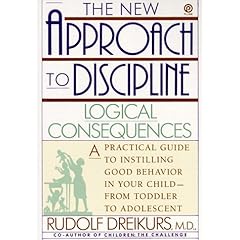
When Richard was almost four, I happened to be reading Logical Consequences by Rudolf Dreikurs and Loren Grey one evening as it was getting on time for the kids to get ready for bed and I decided to try the approach. So, as we were getting ready to get ready, I asked Richard, as per instructions, "It's time to put your toys away. Would you like to put them on the shelf or would you rather I put them in the closet?"

Being perfectly willing to let me do the work, he answered, "You put them away." And so, I got out a box, picked up all the toys on the floor, and put them on the closet shelf. The next day he still had lots of toys to play with, but he did ask for one or two of the ones on the shelf. I explained that they were on the shelf for a week, showed him how to count that off on the calendar, and went about my business. That evening, again I asked what he wanted to do, and again he wanted me to put them on the shelf.

However, now he had not only his very favorite toys, but also his next to the favorite toys in the closet. So on the next day, he asked for a number of toys. Again, we worked it out on the calendar. Again, he accepted it easily.

That evening, when I asked him, I got as far as, "Would you like to " and he broke in with "I'll put them on the shelf." I don't think he ever had me put his toys away again. And, the wonderful thing about it was that he never complained about the toys in the closet.*

Having discovered this miracle answer to discipline, I used it often. And because my children always got to choose*** they did not resist or resent. They could see the logical connection between the choice they made and the consequence, whether that was what they wanted or not. And, because I always asked if they wanted this or that, and never said, "If you don't put them away, I'll put them in the closet (or whatever the choice was)", and always had a logical connection between the choices, we had very few problems.

As they grew older, I stopped offering choices and simply delivered the consequence. When Richard**** was 12, his Uncle Forrest, attempting to be helpful, told him that he was the man of the family. And Richard observed that his grandfather and his uncle didn't pick up their own dinner dishes and put them in the dish washer, like we did. So, having picked up his dishes without fail for ten years, one night he left them on the table. A simple, "Richard, your dishes are still on the table." took care of it that night. But, three nights later, he did it again. This time I didn't say anything. I picked up his dishes and put them in the frig (didn't want the little bugger to get salmonella, after all) and the next morning served his French toast on his dirty dishes. I never had to say anything. It is obvious -- if you don't pick up your dishes, they don't get washed. I didn't say anything. He didn't say anything. But, to this day, you almost have to constrain him to keep him from taking his dirty dishes out to restaurant kitchens.

* It helps with keeping a child's room clean if you use a little Montessori as well as a little Dreikurs. So, my kids never had toy boxes. ** They had shelves at their height. Toys with parts were in containers, and since the box the toys came in would fall apart rather quickly, they had baskets and other containers that wouldn't. And we rotated toys in and out of the room so they had a manageable number. They got to choose what they wanted out at any time, we rotated right after finals when they were little and I was going to school. Every time we would rotate, there were all of those toys they hadn't played with for an entire college semester -- it was like Christmas.

** Toy boxes worked when children had many fewer toys than they do these days, or servants. To get a feel for how unwieldy a toy box is for a child, think about what life would be like if you had no cupboards or drawers or canisters or shelves in the kitchen. If everything had to go in a the box your refrigerator came in. Loose. Once you opened the flour or the rice, the rest of the bag was just dumped in. Everything in your kitchen. In one box. Want to fry an egg? Not only do you have to take out everything you are going to use, but all of the things you aren't going to use between the top and where it has filtered down. Then put it all back, repeat when you need to do something else, put it all back. How long would your kitchen stay tidy?

*** If they had no choice of whether they were going to do it, such as brushing teeth, they got a choice of where or when -- would you rather brush your teeth in the bathroom or the kitchen, before or after your bath?

**** I used to tell lots of these stories to my parenting classes, since concrete examples help teach the concept. Once I noticed that they were almost all about Richard. I mentioned it to Julie, who answered, "I always watched what happened when Richard did something new to find out if it was allowed or not." So, almost all of my Julie discipline stories are about things Richard never did or which were not an issue with him.